Tag: SkinTreatment

Have you ever caught yourself hesitating to wear open-toed shoes or heels? Or have you ever felt like skipping a dip in the pool or a spa day with friends because of how your heels look? That hesitation is usually caused by one thing: dry and cracked heels. No matter how many creams or home remedies you try, rough heels tend to come back.
A heel peel treatment is a foot peel treatment that uses a gel-based exfoliating mixture to soften and remove the dead, thickened skin on cracked heels. Once the old skin sheds, what is left underneath is smoother, softer, and noticeably healthier-looking skin.
If home remedies have stopped working on your heels, here is everything you need to know about this treatment, how it works, its benefits, and whether it is right for you.
What is a Heel Peel Treatment?

A heel peel treatment is an exfoliating skin treatment that uses a special jelly-like mixture applied to the soles of the feet. This softens and exfoliates dead skin, and once the old skin sheds, new, soft, and healthy skin takes its place. It is one of the more effective cracked heel treatments because it works on skin too thick for moisturizer alone.
Did you know? A study in rural Tamil Nadu found foot fissures in 48% of people aged 15 and above, with women accounting for a higher prevalence than men. (Source)
How Is a Heel Peel Treatment Done?
- The first step is consultation, where the therapist checks your feet, listens to your concerns, and explains what to expect from the session.
- Next comes cleansing and disinfecting the feet.
- The heel peel solution is applied and left on for about 15 minutes.
- Once the time is up, a spatula is used to remove the solution along with the dead skin and rough patches. A pumice stone is also used to smooth things further.
- The session ends with a moisturizer applied to hydrate and soothe the skin.
Heel Peel Treatment vs. Traditional Alternatives
A heel peel treatment uses chemical acids to dissolve thick, dead skin, while traditional alternatives rely on physical tools like pumice stones or metal files to manually scrub it away.
Here is the brief difference between traditional foot care and a heel peel treatment:
|
Feature |
Heel Peel Treatment |
Regular Pedicure |
Home Remedies (Pumice/Creams) |
|
Best For |
Deeply cracked, severe calluses, and thick, rough heels |
General foot maintenance, nail care, and relaxation |
Mild dryness and daily moisture upkeep |
|
Exfoliation Method |
Mild dryness and daily moisture upkeep |
Surface-level physical exfoliation (files/scrubs) |
Mild physical filing or topical moisture |
|
Effect on Foot Odour |
High (removes the thick, dead skin where odor-causing bacteria thrive) |
Low to Moderate |
Low |
|
Results Timeline |
Peeling occurs over 1–2 weeks; results last for months. |
Immediate, but roughness returns in a few weeks. |
Gradual improvement; requires daily consistency |
Benefits of Heel Peel Treatment
Cracked heels do not just look rough; they can genuinely hurt when you are on your feet all day. Here is what actually changes once you get this treatment done.
- Smoother, softer skin: Once the dead skin is gone, your heels feel different almost immediately. Creams and oils that used to sit on the surface start soaking in properly, because there is no longer a thick layer blocking them.
- Less odor: Bacteria build up in thickened, cracked skin, which can cause smelly feet. Clearing that skin away cuts down on the bacteria along with it, so your feet stay fresher for longer. (Source)
- Better circulation: Between the massage and the exfoliation, blood flow to your feet gets a real boost. Some people notice less swelling afterward, especially if they are on their feet a lot during the day.
- Relief from sore heels: Hard, calloused skin puts pressure on specific points every time you walk or stand. Softening that skin makes a difference, so everyday movement feels easier.
- Heels that actually look cared for: There is a visible difference once the rough patches are gone. Sandals and open heels become something you can wear without worrying about them.
Who Should Avoid a Heel Peel Treatment

If you have open wounds, diabetes, an active skin infection, or a condition that makes your skin more sensitive than usual, it is best to skip a heel peel treatment or check with a doctor first. The exfoliation is intensive, and skin that is already compromised needs a gentler approach. Here are the cases where it is best to hold it off:
- You are pregnant or breastfeeding.
- You have diabetes, since the treatment is intensively exfoliating.
- You have skin conditions like psoriasis or eczema.
- You have broken, inflamed, or injured skin on your feet.
Heel Peel Treatment Aftercare: How to Care for Your Feet

Your feet need a few days of proper aftercare after a heel peel treatment for the results to actually last. Wash gently, moisturize often, and let the skin shed on its own instead of rushing it.
Here is what that looks like in practice.
- Keep it clean but gentle: Stick to a mild soap and skip the scrubbing for the first few days. Your skin has just gone through a proper exfoliation, so it does not need another round right away.
- Moisturize more than usual: Follow up every wash with a hydrating moisturizer. The new skin underneath is settling in, and keeping it soft now will help prevent the next crack from forming.
- Hold off on other exfoliants: No harsh acids, scrubs, or exfoliating creams for a few days. Your heels are already doing the work of renewing themselves; adding more products on top just irritates skin that is still recovering.
- Leave the peeling alone: If skin starts flaking after the treatment, let it happen naturally. Picking at it slows down healing and can leave patches that look worse than before you started.
How Often Should You Get a Heel Peel Treatment
For lasting results, book a heel peel treatment every six to eight weeks. This gives the new skin time to settle before the next session so you are not exfoliating skin that has yet to fully recover. The treatment usually takes between 30 minutes and an hour, depending on how much buildup there is to treat. You will notice a difference after the first session, though full results show up over the following days as the skin sheds and renews.
Why Get a Heel Peel Treatment From Vurve Salon?
Not every place doing a heel peel treatment is treating it the same way. Many salons squeeze it into a regular pedicure slot and rush the timing, which matters here since the solution needs its full 15 to 20 minutes to actually work. At Vurve Salon, the therapist checks your skin before starting, so someone with thin or sensitive skin is not getting the same approach as someone with years of buildup. The products used are chosen for consistent results rather than the cheapest option available, and the aftercare advice you get is based on what your feet actually need, not a generic printout handed to everyone.
Vurve has 15 outlets, with multiple branches and a team trained specifically in foot and skin treatments, not just hair and nails. If cracked heels have been an ongoing issue for you, that kind of consistency is what makes the difference between a one-time fix and heels that actually stay smooth.
Ready to Get Your First HealPeel Treatment?
Cracked heels are common, but they do not have to stay that way. A proper heel peel treatment gets rid of the thickened skin causing the problem, not just the surface dryness, so the results hold far longer than any home remedy manages.
If your heels have been bothering you for a while, this treatment is worth trying before you write it off as something you just have to live with. Book a heel peel treatment at Vurve Salon and give your feet the fix they actually need
Key Highlights:
- A Personal Arrival: More than a brand expansion, Vurve comes to Hyderabad to answer the long-standing call of its most loyal local guests.
- Intentional Design: The Jubilee Hills space blends Pantone’s Mocha Mousse with Terracotta tones to reflect Hyderabad’s rich, layered heritage.
- Sensory Excellence: From hand-textured walls to custom styling stations, every detail is crafted to provide a tactile, world-class luxury experience.

Hyderabad Called. We Picked Up.
There are cities that accept things. And there are cities that choose them.
Hyderabad has always been the second kind. It has never been in a hurry to be impressed. This is a place that built one of the most recognisable skylines in the world over nine centuries, that trades in pearls and biryani with the same unhurried confidence, that absorbed the entire weight of a technological revolution without once forgetting what it was. When something arrives in Hyderabad, the city takes a moment. It looks. It decides.

Which is exactly why arriving here means something to us.
There is a version of luxury that Hyderabad has always understood intuitively. Not the loud kind, not the kind that announces itself before it walks into a room. The quiet kind. Built on craft that has been practised long enough to become instinct, on materials chosen for how they age rather than how they photograph, on experiences that feel like they were made for you specifically and no one else. Hyderabad has been living this way for centuries. In its architecture, in its food, in the way it dresses for an occasion. The city has always known the difference between something that arrived and something that belongs.
We have always wanted to belong somewhere like this.
Hyderabad has never lacked options. But a specific kind of space has been missing. One where the craft is serious without being cold. Where you walk in and feel known, not processed. Where the hour you spend in a chair feels designed for you, not optimised for turnover. We knew this space was missing. It is, in many ways, exactly the space we have been building in Chennai for years, and the reason we felt the pull of this city before we ever drew a single plan.
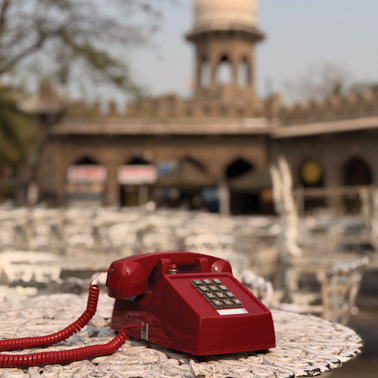
Then a red telephone started ringing.
Not literally. But something shifted, the way it does just before the right thing arrives. A call is going out. A city waiting to see who would pick up.
We picked up.
Vurve Salon is coming to Hyderabad
Not as a franchise rolling out. Not as a brand ticking a city off a list. As an arrival, the kind that takes its time, gets it right, and opens its doors only when the space is ready to mean something. We are a luxury salon collective built over years in Chennai, shaped by stylists who treat hair as both a craft and a conversation. The kind of salon where you are a guest, not a client. Where the people behind the chair have spent years developing a point of view, not just a technique. Where the experience moves at your pace, not the schedule’s.
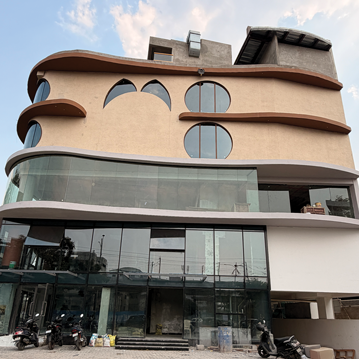
We are not for everyone. But for the people we are for, there is nothing else quite like us. If you ask us why Hyderabad, the honest answer is that it was never really a question.
And for years, some of our most loyal guests in Chennai and Bangalore were Hyderabadis, people who would make the trip, sit in our chairs, and before they left say the same thing: when are you coming to us? We heard it enough times that it stopped feeling like a compliment and started feeling like a calling.

After 13 stores across Chennai, Bangalore and Kochi, we had earned the right to be deliberate about where we went next. We visited Hyderabad many times before we made a decision. What we saw each time was a city growing fast but on its own terms, open to new things, genuinely warm to people who arrived with good intentions, with a culture that felt instinctively close to ours. At Vurve, we have always believed in treating every guest like family. Hyderabad, it turns out, already understood that language.
Where is Vurve Coming in Hyderabad?
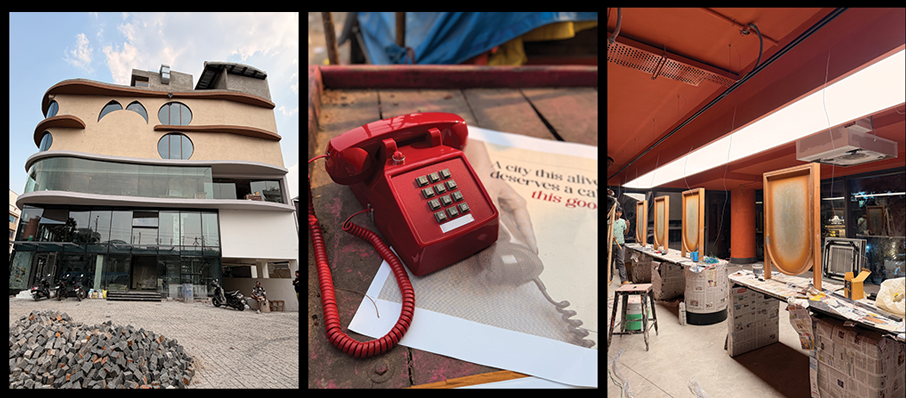
Right now, in Jubilee Hills, we are building that space.

The walls are up. The decisions have been made, argued over, revised, and refined. What you will walk into when the doors open is not an accident. Every surface, every corner, every detail is the result of a process that started long before the first tile was laid.
Rakhee and Shobhit Kumar of RSDA have been designing our spaces for over twelve stores, and in that time, they have learned how we think, how we move through a space, what we will never compromise on and where we like to be surprised. By the time we sat down to talk about Hyderabad, there was no brief to write. They already knew.
“When we began thinking about what Vurve Hyderabad should feel like, the city kept coming back to us. Not just the new Hyderabad, the older, denser, more layered one. The one built in terracotta and heat, and occasionally.”
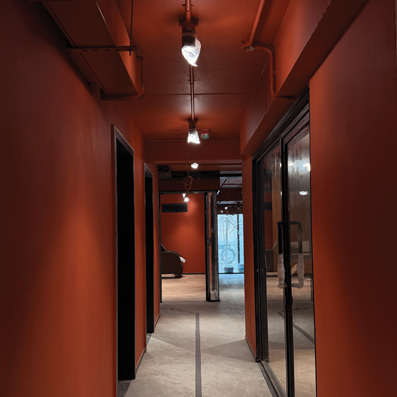
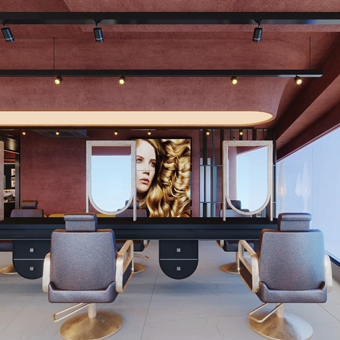
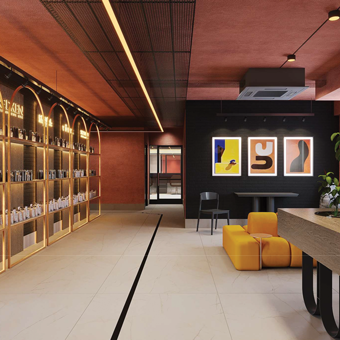
The palette they arrived at reflects exactly that. Mocha Mousse, Pantone’s Colour of the Year for 2025, anchors the space in warmth. Terracotta runs through it as the dominant tone, a quiet echo of the Deccan stone that has coloured this city’s architecture for centuries. The materials are tactile and considered: a wooden partition in rough gangsaw-cut finish for the Wabi Sabi quality it brings, red perforated metal at the pedicure section, hand-textured plaster walls that shift in different light.
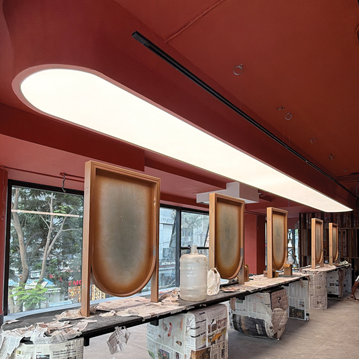
Look closely, and you will find the letter U hidden throughout the space, in the retail desk, the reception counter, the styling mirrors, and the wall panelling. It is a detail most people will never consciously notice. That is precisely the point. The best spaces work on you before you understand them.
At the entrance, a curved red aluminium jaali greets you, a deliberate nod to Hyderabad’s urban spirit and the city’s street-level energy. Inside, the branding builds gradually, from V to Vurve, as you move deeper in. A yellow sofa anchors the reception against warm terracotta walls. Not accidental, entirely deliberate.
“The yellow seating brings a playful contrast,” Shobhit notes, “to break the everyday monotony.”
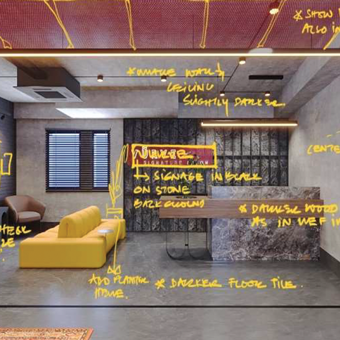
The styling section runs long and open, with gold-footed chairs, arched brass shelving, and light that flatters. The hairspa sits apart, quieter, warmer, with herringbone floors, the kind of room you don’t want to leave. The makeup room has Hollywood mirrors and the kind of honest light that is somehow still kind. The pedicure room glows with a neon sign that reads ‘Be Your Own Kind of Beautiful.’ The beauty room is dark stone and considered calm. Each room is a different register of the same idea: that you deserve a space that thought about you before you walked through the door.
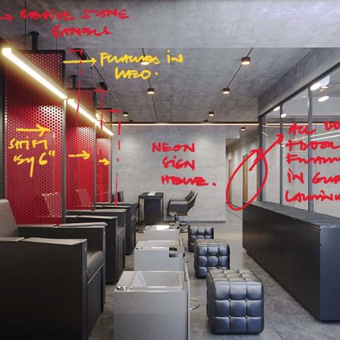
“Each and every detail,” as Rakhee puts it, “is a representation of the client’s aspirations.”
That is the only brief we gave them. We think they understood it.